

More Testimony Transcripts Coming Soon
The Emergence of the “Rectangular” Bruise
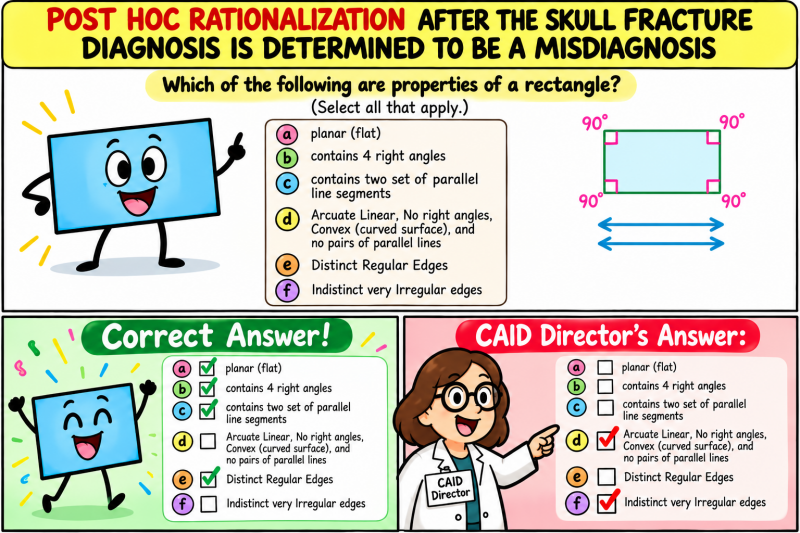
The word “rectangular” deserves particular scrutiny because it appears to have become increasingly important only after the skull-fracture diagnosis—the diagnosis that initially triggered law-enforcement and CPS involvement—was determined to be wrong.
On October 5, 2023, Dr. Lamb learned that there was no skull fracture. Approximately 23 minutes later, she issued her child-abuse evaluation alleging abuse. Rather than documenting the significance of the erroneous skull-fracture diagnosis and ensuring that law enforcement, CPS, and the family understood that the previously diagnosed fracture did not exist, her report attributed a new and highly consequential geometric description to the mother: that the mother had noticed a “rectangular bruise” on the child's forehead on October 3.
That attribution should be compared against the contemporaneous evidence.
The mother did not describe the mark as rectangular. The parents contacted the grandmother who had been holding and burping the infant, and the grandmother provided an explanation involving contact with her jawline that the parents believed matched the mark. The contemporaneous photographs can be evaluated independently: the mark appears arcuate and irregular, without right angles, parallel sides, or distinct regular edges, and with a lighter adjacent splotch.
That raises a straightforward factual question: Where did the adjective “rectangular” come from?
The question becomes more significant because Dr. Lamb subsequently reinforced that characterization.
On October 24—19 days after her examination—Dr. Lamb altered the previously completed report. She added a forehead mark to an anatomical diagram on which no such injury had originally been depicted, other than the documented faint birthmark. Beneath the newly added mark, she described it as brown and rectangular. She also added material concerning review of photographs and characterized the October 3 hospital photographs as showing a rectangular mark.
Thus, “rectangular” was no longer merely an adjective attributed to the mother. It became part of Dr. Lamb's own characterization of the physical evidence.
The contemporaneous descriptions provide an important comparison. The ER described a “small bruise on right side of head.” CPS subsequently described the mark as “really faint.” Other contemporaneous descriptions included “gone,” “disappeared overnight from Wednesday to Thursday,” “barely visible,” and a family text on October 5 describing “zero visible bruise.” The family's Live Photos also preserve the appearance of the mark close in time to the event.
Those records create a testable question. Do the photographs actually depict a rectangle?
A rectangle is not a subjective concept. It has four sides, four right angles, and two pairs of parallel sides. An arcuate mark with irregular or indistinct edges does not acquire rectangular geometry because it is subsequently described with the adjective “rectangular.”
The timing also matters.
When Dr. Lamb issued her October 5 report, the central medical premise that had triggered the emergency response—a diagnosed skull fracture—had just collapsed. The sole eyewitness to the handling incident had apparently not been interviewed despite being available, including while present at the hospital, and despite her contact information having been provided. Law enforcement had initially been contacted concerning the diagnosed skull fracture, and CPS had likewise been told that a skull fracture existed.
Against that chronology, the appropriate question is not simply whether Dr. Lamb could use the word “rectangular.” It is:
What contemporaneous evidence supported that geometric characterization, who first supplied it, and when?
If the mother's actual communications do not contain that description, the attribution to her should be examined particularly carefully. If the contemporaneous photographs do not depict a rectangular injury, the later repetition of that adjective in the altered October 24 report and in testimony becomes even more significant.
This matters because Dr. Lamb later relied upon the purportedly rectangular configuration in testimony when rejecting the family's accidental explanation. The adjective therefore was not incidental. It became part of the reasoning used to distinguish an allegedly inflicted injury from the family's explanation.
The sequence can be stated without speculating about Dr. Lamb's state of mind:
First: a skull fracture was diagnosed.
Then: the family and investigators evaluated the circumstances in light of that diagnosis determining that a burping incident was likely not a cause. Grandma was therefore not interviewed.
Then: the skull fracture was determined not to exist.
Approximately 23 minutes later: Dr. Lamb issued an abuse report containing an attribution that the mother had described a “rectangular bruise.”
Nineteen days later: the finalized report was altered to add a forehead mark to the anatomical diagram and additional “rectangular” descriptions.
Later in court: “rectangular” became a repeated feature of the testimony used to reject the accidental explanation.
NOTE: Parents are investigating "notes" from CPS that were entered AFTER Dr. Lamb communicated with them her concern that the parents were fixated on the skull fracture. The CPS Caseworker added a "rectangular" adjective to her depiction of the bruise on Wednesday while also describing it to Law Enforcement as "really faint" and also added it to the 10/5 description when she called it "barely visible". A bruise that starts out irregular, grows to faint, barely visible, and then non-existent the day of Lamb's exam seems unlikely to grow in geometric specificity.
Given the issues with CPS and "coordination" of the facts to align with Dr. Lamb, but not align with records, the family has concern as both notes were done or edited after the actual observations. The family understands that pressure is put on DCYF staff to stay in line with, and not question Med Con Providers.